
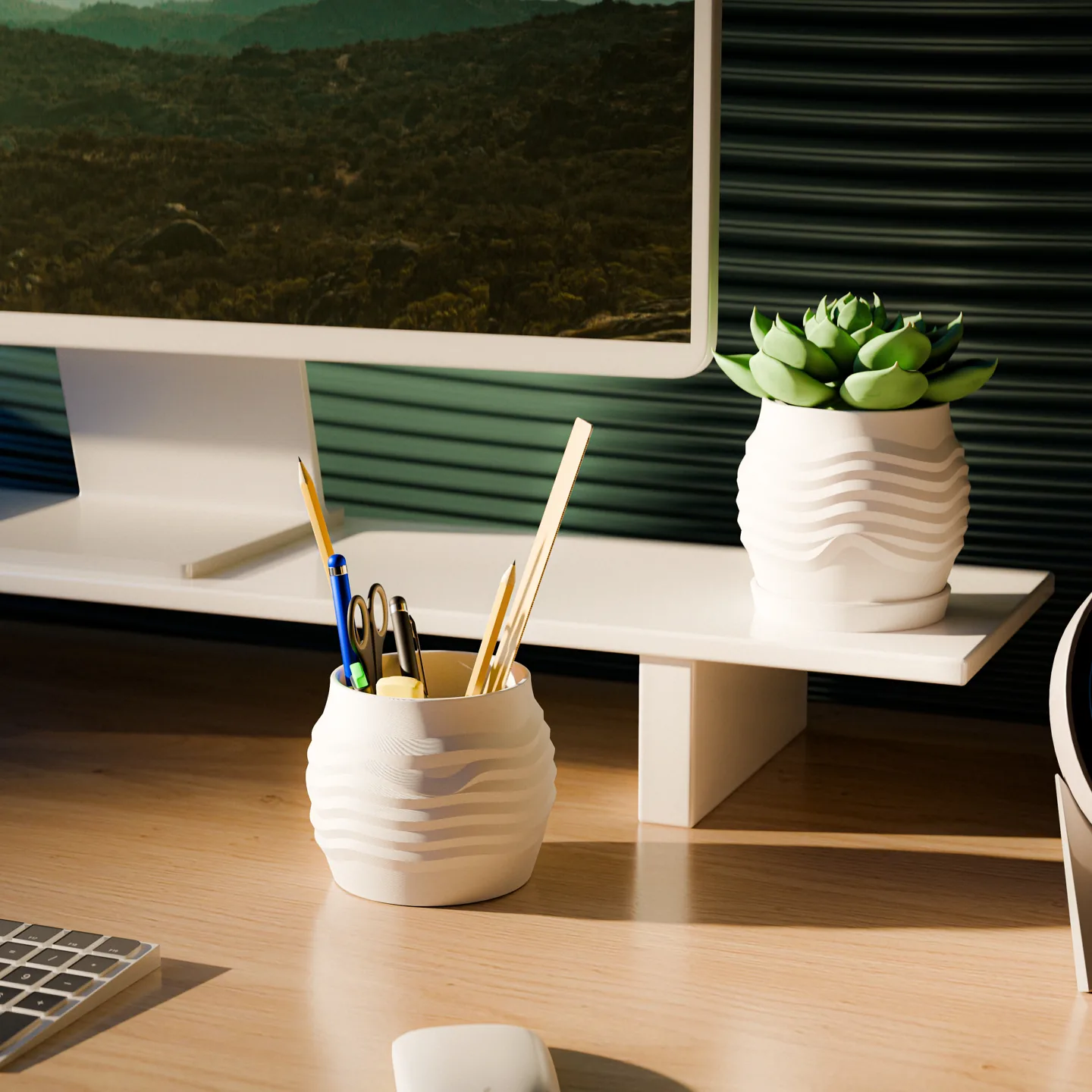
Example images of the design. You choose the colour yourself when you order; we print in the colours from our filament palette.
Flow Planter: plant pot with wavy relief and saucer
€54.45 incl. VAT
€45 excl. VAT · free shipping in the Netherlands · delivered within 30 days
Flow Planter gives a small plant a home with character. Horizontal waves run around the pot, with a matching saucer underneath.
- Decorative vase or pot. For fresh flowers, use a watertight insert.
- You choose the colour yourself from 15 filament colours.
- Printed after payment and delivered within 30 days.
- 14-day cooling-off period after receipt.
Order Flow Planter
Shape, details and use
Discover Flow Planter
The wavy outside makes Flow Planter a calm accent on a desk, shelf or windowsill. The design suits a small plant or succulent; the example images also show the pot on its own and the saucer.
Put the plant in a suitable inner pot. The saucer catches some water, but it does not make the outer pot watertight. When you water, check whether moisture stays under the pot, and protect the surface of your furniture.
How ordering works
- Choose a colour and the quantity, and enter your delivery address. We check postcode and house number against the Dutch address register.
- You pay the total incl. VAT via Stripe. Shipping within the Netherlands is included.
- You receive a confirmation by email. We print Flow Planter in your colour and ship it within 30 days.
Want Flow Planter in a different size or in a larger quantity? That is custom work: request it via the form.
Vase guide
Plant pot with or without a drainage hole: what do you need?
A plant in a pot without a hole soon drowns, because excess water has nowhere to go. So use a pot with a drainage hole and a saucer underneath, or keep the plant in its nursery pot inside a decorative pot (cachepot) without a hole. With a 3D-printed pot, the nursery-pot-in-cachepot method is the safest.
Why drainage matters
Most houseplants do not die from too little water, but from too much. When water stays at the bottom of the pot, the roots get no air and start to rot. A hole in the bottom lets excess water run off, usually into a saucer that you empty afterwards.
- Pot with a hole and a saucer: plant directly, excess water runs off
- Cachepot without a hole: the plant stays in its plastic nursery pot inside it
- After watering: check after a quarter of an hour whether water is standing at the bottom and pour it away
- A layer of clay pebbles at the bottom of the cachepot keeps the nursery pot above any water
Why an inner pot is smart with 3D prints
3D-printed pots are built up from layers. Even when they seem watertight, moisture can seep into the fine seams between the layers over time, and soil that stays damp for long is not good for the material. With the plant in its own nursery pot, the inside of the printed pot stays dry, and you can easily repot the plant or water it over the sink.
If you have a succulent or cactus that needs little water, the risk is smaller. Give small amounts and let the soil dry out in between.
Flow Planter: pot and saucer together
Flow Planter gives a small plant a home with character: horizontal waves run around the pot, with a matching saucer underneath. The size is meant for a small plant, such as a succulent, cactus or cutting, on a desk, shelf or windowsill. The saucer catches any drips, so your furniture stays dry.
Preferably put the plant in a small nursery pot inside Flow Planter. Then you get the best of both: the shape of the printed pot and the certainty of an inner pot.
Which plants fit a small pot
For a small pot on a desk or shelf, choose plants that grow slowly and need little water: succulents, small cacti, a haworthia, a small pilea cutting or a tillandsia without soil. Larger or fast-growing plants soon need a bigger pot. If in doubt, choose a plant that sits in a 5 to 6 centimetre nursery pot in the shop.
More vases and plant pots
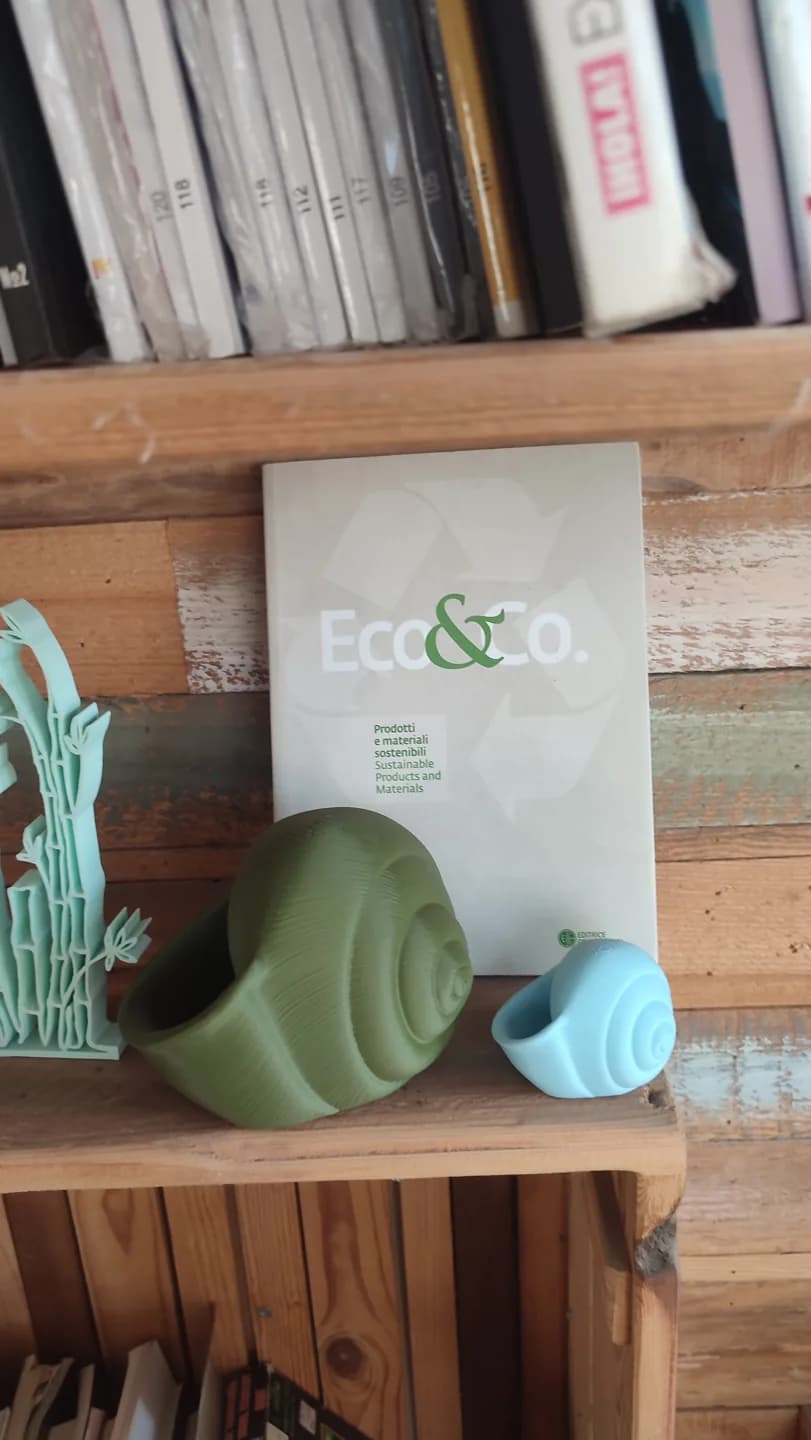
Natica
Natica brings the spiral of a seashell into your home. The low, lying shape has an opening at the side and a rounded whorl at the end.