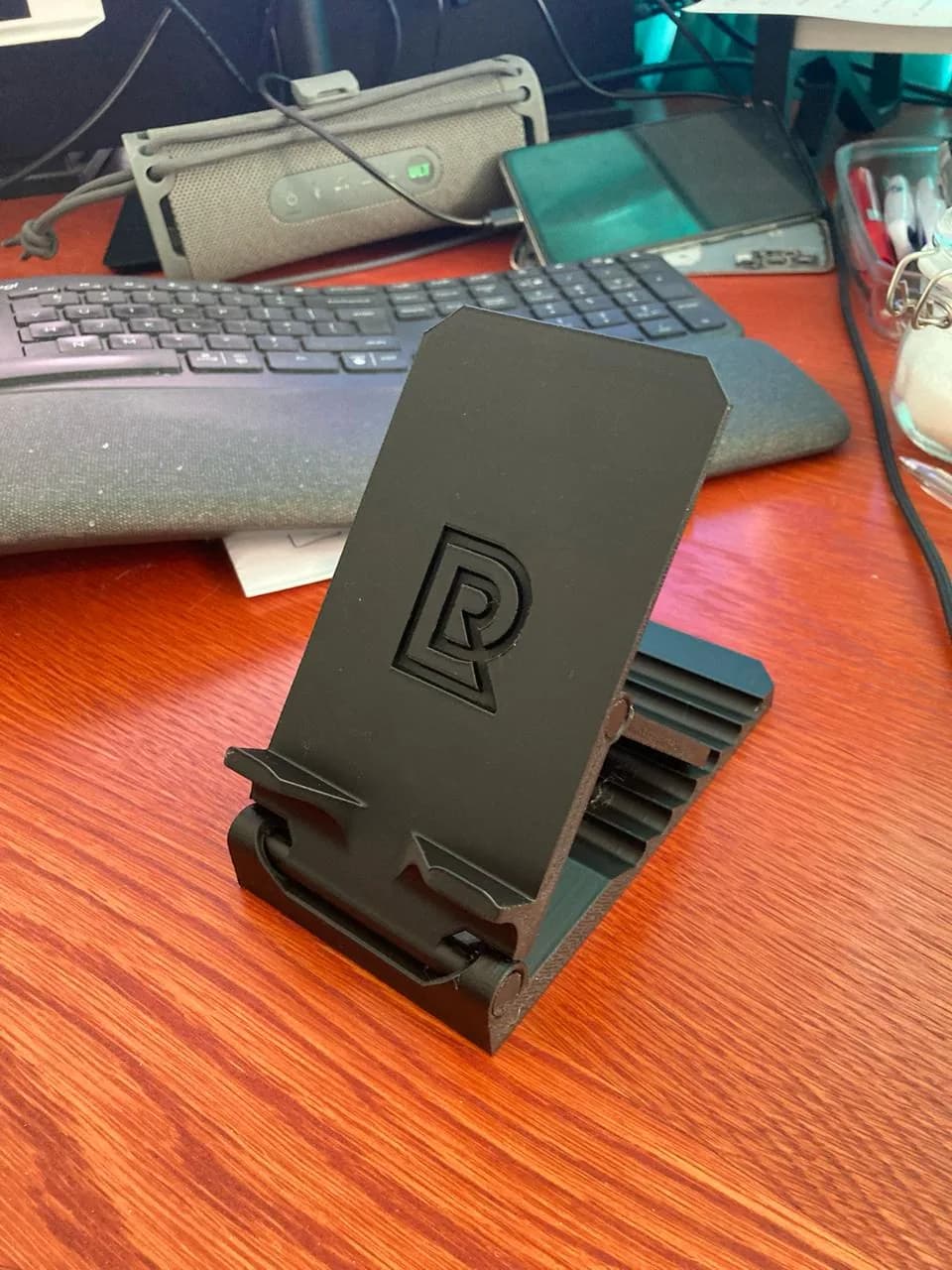
CAD design for 3D printing
Have a 3D model made — from a sketch, a photo, or a description.
There is no shortage of free models on the internet. There is a shortage of models of the specific thing you need, at the right size, that will survive being printed. This is the modelling step: someone turns your intent into geometry that a machine can actually make.
How do I get a 3D model made for printing?
Describe what the object has to do, supply whatever you have — a sketch, photographs, dimensions or a similar object — and name the critical measurements: what it must fit onto, and with how much clearance. Everything else can be decided during modelling. What cannot be decided later is the dimension that has to match something in the real world.
Designing for print is not the same as designing
A model can be geometrically perfect and still be a poor print. Wall thickness against the nozzle or laser spot, overhang angles and where supports will scar the surface, layer direction against the direction of load, clearance for parts that must slide or snap together, shrinkage on the long axis — these are decided in the model, not at the printer.
Four common starting points
A sketch with dimensions is the fastest. Photographs of an existing object plus a scale reference work well for shapes that need to fit something. A verbal description works when the object is genuinely new. And an existing file — downloaded, inherited or exported from the wrong software — often needs repair or rebuilding rather than modelling from scratch.
- a sketch, with the measurements that matter
- photographs including a ruler or caliper
- a written description and a purpose
- an existing file that does not print correctly
Can AI make the model for you?
Text-to-3D tools and chat assistants can produce a mesh, and for decorative or visual objects that is sometimes enough. What they do not reliably produce is a part that fits a real object: exact clearances, wall thicknesses that survive load, features that mate with something you already own. If a generated file gets you eighty percent of the way, bring it — repairing and re-dimensioning it is often cheaper than starting again.
Parametric where it pays
A model built with real features and relationships can be re-dimensioned later; a model built as a frozen shape has to be redone. Where a part is likely to change — a size variant, a different mount, a second version after the first is tested — the extra care during modelling is what makes the second version cheap.
What modelling costs depends on decisions, not hours alone
A well-specified single part with clear critical dimensions is a contained job. An open-ended shape with 'see what looks good' is not, and neither is a part whose requirements change after the first print. The quote states what is included, how many revision rounds it covers and what a further change costs.
Quoted separately and confirmed in writing before anything starts. An enquiry becomes an order once application, scope, price, schedule and responsibility are agreed.
Frequently asked questions about having a 3D model made
Where can I find a 3D model making service?
Start an enquiry describing the object and its purpose. Modelling is quoted as its own work, separately from printing, so you can see what each part of the job costs.
How much does it cost to have a 3D model made?
It depends on complexity, how well the requirements are specified and how many revision rounds are expected — not on file size or triangle count. A clear brief with critical dimensions is the cheapest brief.
Can ChatGPT make 3D models or STL files?
It can produce mesh geometry, and for decorative objects that can be enough. It is unreliable for parts that must fit something real, where clearances and wall thicknesses decide whether the part works. A generated file is a fine starting point and a poor finished part.
What do you need from me to start?
What the object must do, what it must fit, the measurements that cannot be wrong, and any sketch, photo or file you already have.
What is the difference between a mesh and a CAD model?
A mesh describes a surface as triangles and is what printers consume. A CAD model describes features and relationships, so dimensions can be changed later. Which you need depends on whether the design is finished.
Can you fix a model I already have?
Often. Repair, rescaling and thickening are usually cheaper than remodelling — though when a file is badly built, rebuilding it can be the faster route, and we say which it is before starting.
Do I own the model you make?
Ownership and use of the resulting files are recorded in the proposal before work starts, rather than left implicit.
From a file, a part or an idea to a quote that holds.
Describe what the part has to do, what you already have, how many you need and when. We confirm the missing requirements first and make a proposal after that.
