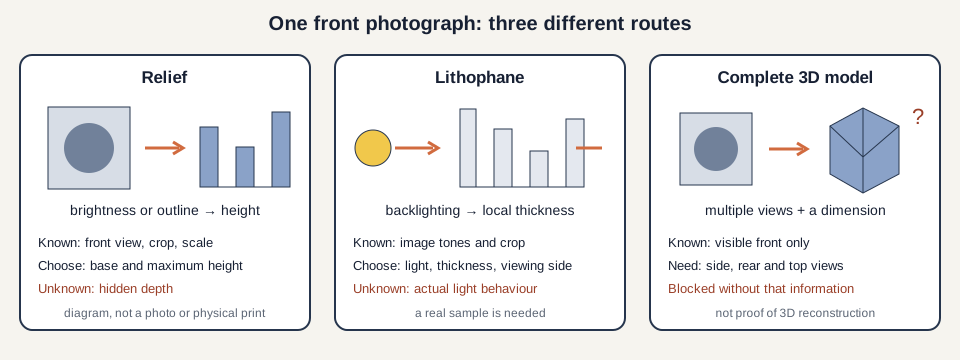
One photograph records colour and brightness from one viewpoint. It does not establish the depth or shape of hidden surfaces. Choose an outcome that the available information supports: a tactile relief, an image seen with backlighting or a fully three-dimensional object.
Download the English project worksheet. Open it as UTF-8 CSV, replace the guide context with your project inputs and record observations separately from acceptance decisions. Blank cells do not indicate a passed check.
Check the image and permission first
Use your own photograph or record permission. Keep the original rather than a compressed screenshot, and note the crop, resolution and visible blur. Conversion cannot restore detail that the image never captured.
For a relief, brightness or drawn contours become height above a flat base. This suits a logo, silhouette or portrait viewed from the front. Agree outside dimensions, base thickness, maximum relief height and background treatment. If the source is vector artwork, use the SVG-to-relief checks to inspect closed outlines and small openings at final size.
A lithophane needs a lighting plan
A lithophane varies local thickness to transmit different amounts of light. Image contrast, thickness, material, light source and viewing direction all affect the result. It is not an ordinary colour photograph. Specify where the light sits and how the panel will be viewed, then assess a real sample under that lighting.
Collect views for a complete object
A complete object requires front, side, rear and top information plus at least one reference measurement. Photogrammetry uses overlapping photographs to infer spatial information. A single view cannot prove concealed geometry.
| Available source and intended result | First route | Information still needed |
|---|---|---|
| One front image, tactile picture | Relief | Height interpretation and border |
| One image, backlit panel | Lithophane | Lighting, thickness and trial |
| Recognisable object from every side | Full model | Multiple views and dimensions |
This is a decision aid, not a physically tested product. The original comparison diagram illustrates height above a plane, backlighting through varying thickness and unknown rear geometry. It is an editorial diagram, not a photograph, generated model or physical-print proof.
A completed planning example
Imagine a frontal portrait with 2,400 × 3,000 pixels, an intended height of 120 mm and a straight-on viewing direction. Backlighting is unwanted and side and rear views are absent. A flat relief with a crop trial is a feasible starting point. A lithophane does not match the lighting requirement, and a complete model remains blocked by missing views. The relief's height interpretation still needs deciding.
Resolution only helps assess image information for the chosen crop. It is not a promise of printed detail.
Mark what the source cannot establish
Record a real width, height or diameter visible in the source. Mark surfaces concealed by perspective, hair, shadows or other objects. The modeller should not silently fill these gaps as if measured.
Record the image-to-height interpretation
For a lithophane, check black and white points, important midtones and crop. For relief, define which tones become high or low and how the border and background work. These are handover choices. A generated trial file and physical sample are still needed to judge the translation.
Stop if the request assumes a photorealistic complete object from one view, permission is unknown, scale is missing or the lithophane's light source is undecided. Obtain extra views, a sketch or agreement on a simpler outcome.
Request the result you intend to view
For a backlit image, send the original photograph, crop and panel dimensions for a custom lithophane. Say whether you need only the panel or want to discuss a holder and lighting. Those components do not follow automatically from converting the image.
For a relief or complete object, request a 3D modelling assessment, identifying measured views and geometry still to be designed. When you receive an STL, check its dimensions and shape before arranging production.